LET'S GO
Vernier – Shaping a New Urban Centre
As Blandonnet–Étang and Concorde continue to evolve, Vernier is establishing itself as a new centre of gravity within Greater Geneva.
Industrial estates, fuel depots, motorway interchanges and commuter flows: for decades, Vernier carried the image of a territory people passed through rather than truly experienced. A fragmented, peripheral municipality whose role often seemed purely functional. Yet with nearly 39,000 residents and more than 2,000 businesses, Vernier is now the second-largest municipality in the Canton of Geneva - and one of its key economic hubs.
Today, that gap between perception and reality is steadily narrowing. Over the past decade, Vernier has undergone a profound transformation. New mixed-use neighbourhoods, the arrival of major economic players, reimagined mobility infrastructure, large-scale environmental projects and ambitious public facilities are gradually reshaping the area. A different picture is emerging: that of a growing urban centre on Geneva’s right bank.
A Territory Long Divided
A glance at the map is enough to understand Vernier’s singularity. Rather than developing around a single centre, the municipality grew as a mosaic of neighbourhoods divided by Motorways, railway lines and major roads. Le Lignon, Les Avanchets, Châtelaine-Concorde, Blandonnet, Étang and the historic village of Vernier. All geographically close, yet long separated in practice. Some areas are highly residential, while others are home to economic or industrial activities. Between them, continuity has often been limited, and porosity lacking.
Today, the challenge is clear: reconnect these fragmented pieces into a more coherent whole. This involves tangible interventions — new pedestrian and cycling links, footbridges and redesigned public spaces - but also a broader shift in mindset. Less space devoted to cars, more room for active mobility.
The Passerelle de l’Aventure is a striking example. Since spring 2026, a temporary crossing has enabled pedestrians and cyclists to travel between the Étang district and Blandonnet. In the longer term, it will connect Les Avanchets, Étang, Blandonnet and Vernier railway station, creating seamless soft-mobility links where physical barriers once dominated.
The Voie Verte (Greenway) follows the same logic. Already connecting Saint-Jean to Blandonnet via Concorde, Écu and Étang, largely away from motor traffic, it allows cyclists to travel from Saint-Jean to Étang in around eleven minutes. By 2029, the Greenway is expected to extend as far as Meyrin and Satigny along the railway corridor.
"The goal is to make alternatives to the car attractive enough to bring about lasting changes in behaviour ", says Igor Moro, Head of Urban Planning for the City of Vernier.
Blandonnet–L’Étang: From Corridor to Neighbourhood
If there is one place where this transformation is particularly visible, it is the Blandonnet–L’Étang area. Wedged between the A1 motorway, railway lines and fuel storage facilities, it hardly seemed destined to become a place where people would choose to live.
And yet, change began as early as the late 1990s with the arrival of the Touring Club Switzerland headquarters. During the 2000s, the tertiary business district expanded with several office developments, including BIRD and LINK, while the fully renovated shopping centre strengthened the area’s appeal.
Since 2023, the development of the Étang district has played a decisive role in reshaping the area. Built on a former industrial brownfield site, this new mixed-use neighbourhood now accommodates more than 2,500 residents alongside approximately 50,000 square metres of commercial and office space — all designed according to demanding sustainability standards.
Major organisations, including Edmond de Rothschild and BCGE, have chosen to establish a presence there, further reinforcing the site's attractiveness.
In just a few years, the area has evolved from a transit corridor into a vibrant, well-structured urban district. Today, Blandonnet and Étang are increasingly functioning as a single urban entity.
Concorde: A Place of Convergence
Further east, the Châtelaine–Concorde area is preparing to become one of the key focal points of this urban transformation. Long dominated by infrastructure and major transport corridors, the district is now at the heart of a large-scale regeneration programme driven by the Concorde Neighbourhood Master Plan.
The ambition is to create a connected eco-district centred around housing, redesigned public spaces, a future railway station and a new orbital tram line linking Grand-Lancy to the airport area.
One project in particular may come to symbolise this transformation: Concorde Espace Culture, due to open on 25 September 2026.
Spanning 27,000 square metres – a scale rarely seen in Geneva-, the complex will bring together a modular performance hall, dance, music and recording studios, a library, a hotel, a restaurant, as well as student and social housing.
Inspired by European cultural hubs and third places, Concorde is built around the idea of hybridisation. Visitors might come for a coffee, stay to work, rehearse, record music, attend a performance or take part in a workshop. Activities overlap, audiences mix and different rhythms of life coexist. Hospitality lies at the heart of the project.
"We do not want to create just another cultural venue, but a genuine hub for social and civic life," explain co-directors Eve-Anouk Jebejian and Frédéric Steinbrüchel.
Concorde Espace Culture will be deliberately broad and inclusive, spanning contemporary dance, hip-hop, electronic music, circus arts, magic and stand-up comedy, with a strong focus on accessibility and audience diversity.
The project is also deeply rooted in its local context, with artist residencies, cultural outreach programmes and collaborations with schools and community organisations designed to foster long-term engagement with the surrounding area.
Beyond the neighbourhood itself, Concorde addresses a wider cantonal challenge. Geneva’s cultural offer has historically been concentrated on the left bank. "Concorde is taking root in a territory that is both unconventional and incredibly fertile.", say the two directors.
"It is exciting to contribute to the emergence of the city of tomorrow."
Eve-Anouk Jebejian & Frédéric Steinbrüchel
Building Differently
This transformation does not come without constraints. Vernier remains exposed to significant challenges, including road traffic noise, air pollution, proximity to the airport and heavy traffic volumes.
As a result, the municipality now advocates a more selective approach to densification: building more, certainly, but not at any cost.
Air quality, thermal comfort, urban greenery, and the quality of public spaces now play a central role in planning decisions. This translates into concrete measures such as removing impermeable surfaces, restoring natural environments, promoting urban agriculture and enhancing existing natural assets, including the Rhône riverbanks and the Bois des Frères woodland.
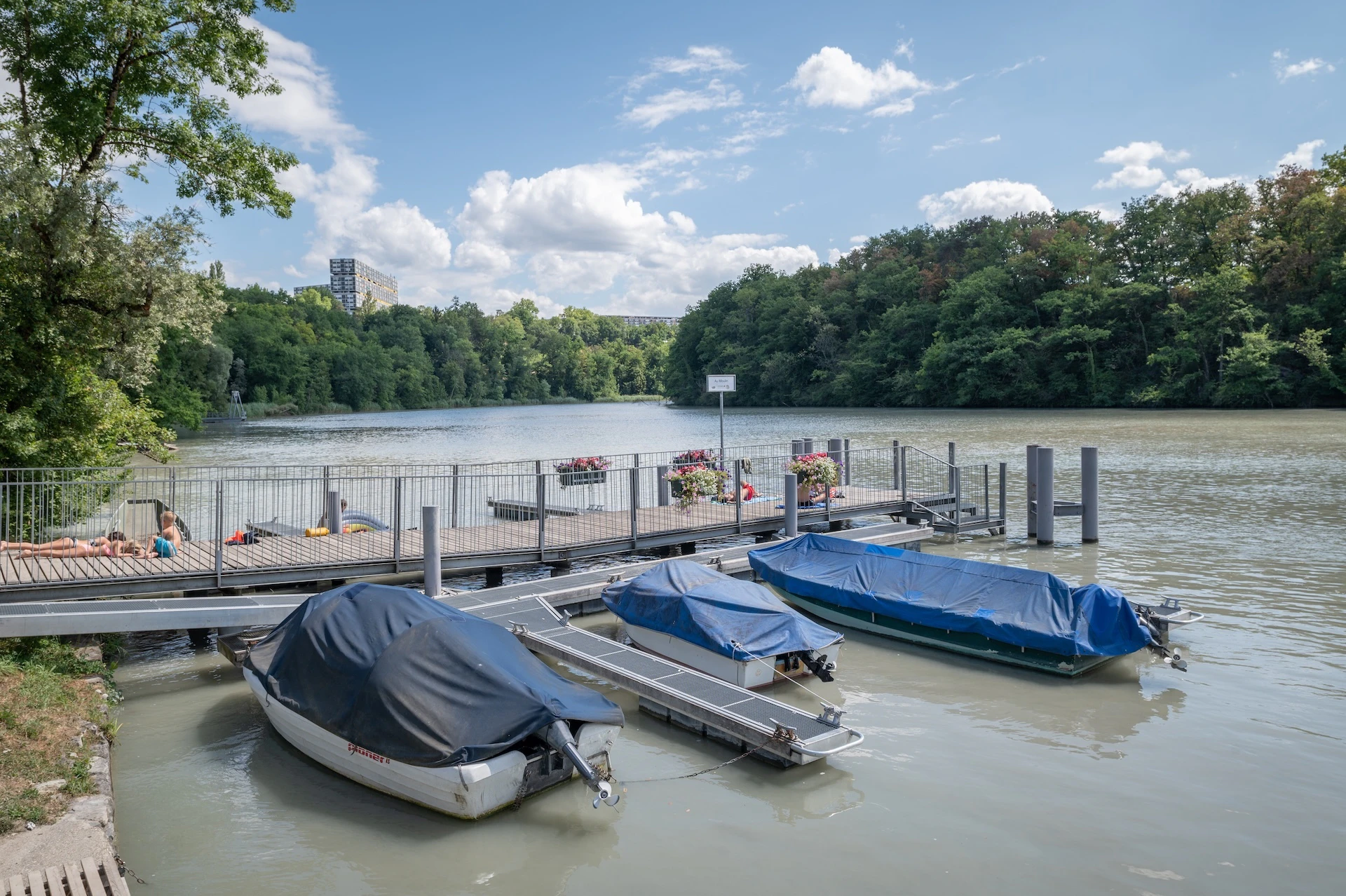
This renewed attention to landscape and biodiversity is also helping to reshape perceptions of Vernier. Beyond its infrastructure, the municipality reveals quieter, greener and often unexpected places, just minutes away from some of Geneva’s busiest transport corridors.
"Vernier is a place where it is worth taking the time to linger, with surprising contrasts and hidden gems."
Igor Moro
A Change of Scale
Mixed-use neighbourhoods, new mobility networks, major public facilities and redesigned public spaces: taken together, these projects point to a profound transformation. Vernier is no longer simply a functional suburb. It is becoming a place where people live, work and move differently.
The transformation is still underway, and its full impact will only become clear over time. Yet one shift is already evident: Vernier is gaining coherence, attractiveness and recognition.
In the process, the mental map of Greater Geneva is evolving as well. In this new landscape, Vernier is no longer on the margins. A new urban centre is taking shape.
Photos credits
© Vernier: Nicolas Dupraz, David Mayenfisch and Ville de Vernier
© Concorde: Sébastien Moritz and HRS
© BIRD: Jeremy Wilson